 Zyrox
ZyroxHow to Set Up a Home Office PC for Productivity
Create a home office workspace that supports focus and reliable performance. Covers hardware, peripherals, ergonomics, and software essentials.
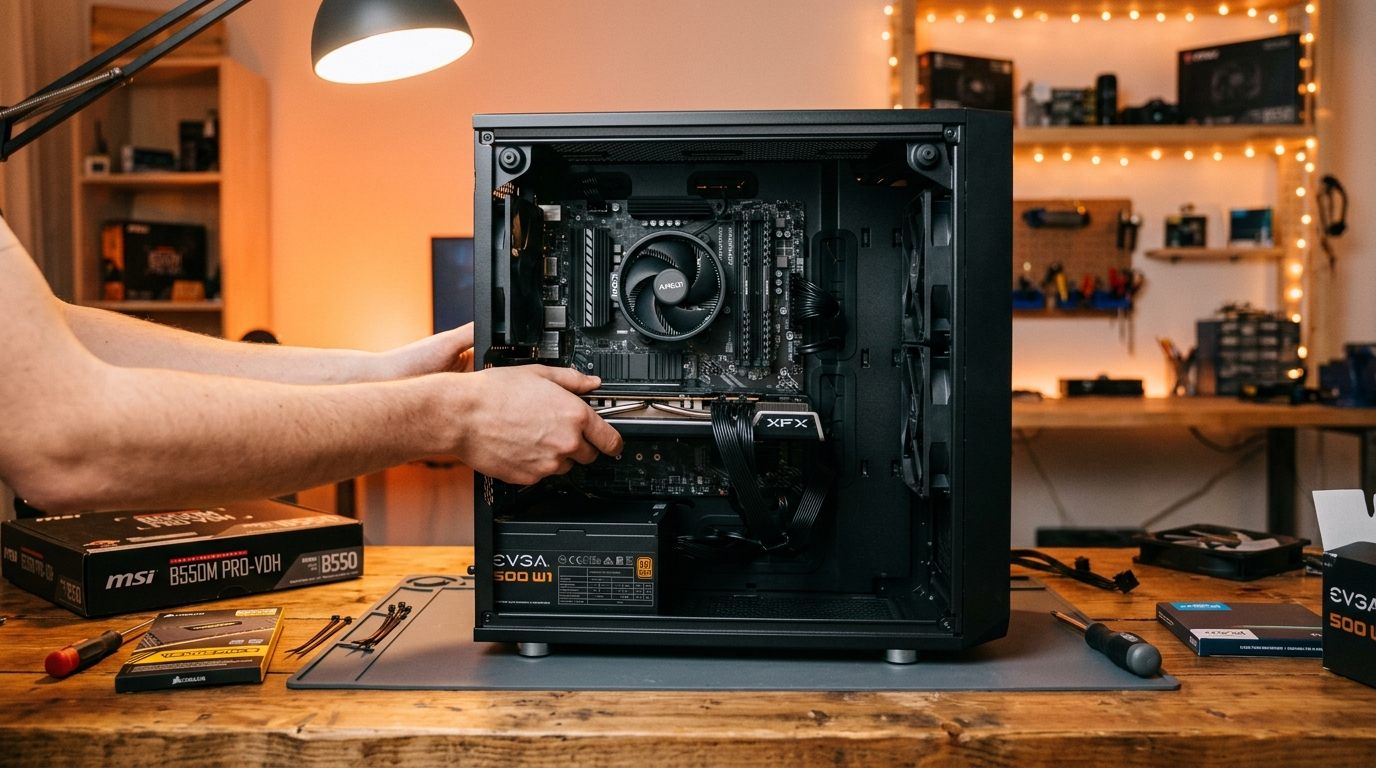 I spent the better part of two years working from a setup that was genuinely embarrassing. A hand-me-down gaming chair shoved against the wall, a monitor sitting flat on a stack of textbooks, a mechanical keyboard I chose because it looked cool rather than because it felt good to type on for eight hours. I got things done, but I ended the day with neck tension, eye strain, and a mild sense of dread about sitting back down the next morning.
Then I actually rebuilt the setup properly — not by spending a fortune, but by being deliberate. The difference was immediate and stayed. This guide covers everything I changed and why, from the monitor position down to the cable clips.
Monitor Placement and Ergonomics
This is the most impactful change most people can make, and it costs nothing if you already have an adjustable stand.
The top of your screen should sit at or slightly below eye level. If you have to tilt your head up to see the top of the display, your neck will pay for it by the afternoon. The viewing distance should be roughly an arm's length — about 50 to 70 cm. A slight backward tilt of 10 to 15 degrees reduces glare and makes the lower screen easier to read without hunching. I use an Ergotron LX monitor arm, which makes dialing this in a five-minute job.
If you use two monitors, set the secondary one at a slight inward angle so you aren't rotating your neck to look at it.
Desk and Chair Interaction
The desk and chair dictate where everything else goes. If your chair doesn't adjust to let your elbows rest at 90 degrees while typing, no monitor adjustment will fix your strain.
I use a Flexispot E7 standing desk, alternating between sitting and standing. I keep my PC tower on the floor, which clears desk clutter and stops vibrations from buzzing through the tabletop. If you have a fixed-height desk, getting a monitor arm and a keyboard tray gives you the best ergonomic flexibility.
The Right Monitor for Work: 27-Inch 1440p IPS
For productivity, you need a balance of panel quality, resolution, and size. A 27-inch IPS display at 1440p is the sweet spot. Text is incredibly sharp, reducing eye strain for long reading sessions.
The Dell UltraSharp U2722D is my daily driver. It's a 2560x1440 IPS panel with phenomenal color accuracy and a USB-C hub that lets me dock my laptop with one cable. Other great options include the LG 27UK850-W (if you need 4K) or the ASUS ProArt PA278QV for factory-calibrated color. The BenQ GW2780T is a fantastic 1080p budget pick with eye-care tech.
Just avoid VA panels for text work (scrolling causes blurry ghosting) and TN panels (color shifting is miserable).
Keyboard and Mouse for Long Sessions
Mechanical keyboards last longer and feel incredibly consistent, but you have to pick the right switches for a home office.
Linear switches like Cherry MX Red, Gateron Red, or Cherry MX Silent Red are smooth, require low force, and don't have that sharp, clicky clack that drives housemates insane. The Keychron K2 and K8 Pro are fantastic starting points. If you prefer membrane or need ergonomics, the Logitech MX Keys or Microsoft Sculpt Ergonomic Keyboard are superb for wrist health.
For mice, the Logitech MX Master 3S is unbeatable. The smooth scroll wheel, thumb shortcuts, and precise sensor make spreadsheets and massive documents much faster to navigate.
Noise Reduction: Quiet Fans and SSD
A noisy PC drains your focus. If you still boot from a mechanical HDD, replace it with a silent SSD like a Samsung 990 EVO (NVMe) or Samsung 870 EVO (SATA). HDDs click and whir all day; solid-state drives are completely silent.
Swap out cheap case fans for Noctua NF-A12x25 or be quiet! Silent Wings 4 fans. They move air efficiently at low RPMs, keeping your system essentially inaudible during the workday.
Essential Software Setup
A clean Windows install makes a massive difference. OEM bloatware and notification spam add constant friction.
Start with a fresh install of Windows 11 via the Media Creation Tool. Install Firefox with uBlock Origin or the Brave browser for ad blocking. Disable all unnecessary startup apps in Task Manager. Install PowerToys to use FancyZones for snapping windows into custom grids. Use an app like Freedom to block distractions during deep work, and rely on Bitwarden for password management.
Internet Connection Stability
If you do video calls or cloud syncs, run a wired Ethernet cable. WiFi 6 is fast, but packet loss during a Zoom call is almost always a WiFi problem. A Cat 6 cable costs nothing and solves everything. If you can't run a wire, look into a TP-Link powerline adapter to route Ethernet through your wall outlets.
UPS for Power Protection
An Uninterruptible Power Supply (UPS) is mandatory if you work from home. A sudden power flicker can corrupt databases or wipe out an hour of writing.
The APC Back-UPS Pro 1500VA is the gold standard here. It provides about 15 minutes of runtime for a typical PC, which is plenty of time to save your work and shut down. It also features Automatic Voltage Regulation to protect against silent low-voltage brownouts. The CyberPower CP1500PFCLCD is another great option with pure sine wave output. For a lighter budget, the APC 700VA gives about 8 minutes of backup.
Cable Management Tips
Visual clutter adds mental load. Start by mounting a J Channel cable raceway or an IKEA SIGNUM rack under the back of your desk. Route power bricks and hubs underneath using velcro straps. Switch to a wireless mouse and keyboard if you can, or use a binder clip on the desk edge to keep wired cables trained neatly in one spot.
Lighting and Eye Strain
Ambient lighting behind your monitor (bias lighting) drastically reduces eye strain. The BenQ ScreenBar Halo or Elgato Key Light are fantastic for this. Ensure natural window light is to the side of your monitor, not directly behind it (causing glare) or in front of it (causing the screen to look dim). Set your monitor brightness to match a blank white piece of paper held next to it in the room.
The Real Difference
Before my overhaul, I used a 1080p TN monitor sitting on books, a loud clicky Razer keyboard, a cheap optical mouse, a slow HDD, and WiFi. I had awful neck pain and eye strain by 4 PM.
After upgrading to an Ergotron arm holding a 27" 1440p IPS display, a Keychron K8 Pro, an MX Master 3S, a fast NVMe SSD, wired ethernet, a UPS, quiet Noctua fans, and a BenQ ScreenBar, the change was staggering. The neck pain vanished. The eye strain disappeared. The room was quiet, and the machine felt infinitely faster. It was the best investment I ever made in my own productivity.
Related Guides
← Back to home